
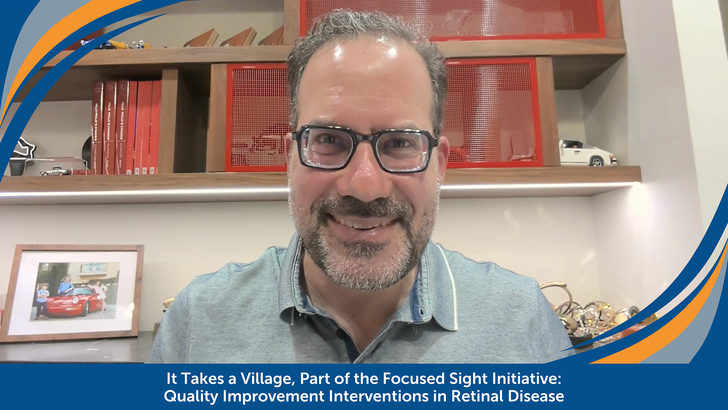
In this didactic case presentation, Dr. David Eichenbaum discusses an 88-year-old patient with non-central geographic atrophy who received inappropriate bevacizumab treatment due to uncoordinated care after relocating seasonally. The case illustrates challenges that can arise in managing retinal disease across geographically distant sites. Dr. Eichenbaum emphasizes opportunities for improved referral handoffs, patient education, and system-based solutions to ensure continuity of evidence-based treatment.
It Takes a Village, Part of the Focused Sight Initiative: Quality Improvement Interventions in Retinal Disease

Transcript
It Takes a Village, Part of the Focused Sight Initiative: Quality Improvement Interventions in Retinal Disease
closeTranscript
It Takes a Village, Part of the Focused Sight Initiative: Quality Improvement Interventions in Retinal Disease
closeTranscript
It Takes a Village, Part of the Focused Sight Initiative: Quality Improvement Interventions in Retinal Disease
closeAnnouncer:
Welcome to CE on ReachMD. This activity, titled “It Takes a Village” is provided by Evolve Medical Education.
Prior to beginning the activity, please be sure to review the faculty and commercial support disclosure statements as well as the learning objectives.
Dr. Eichenbaum:
I’m David Eichenbaum from Retina Vitreous Associates of Florida, director of research, and from the Morsani College of Medicine at the University of South Florida, and I’m very excited to present this case. This is a perfect case to talk about quality improvement and quality assurance. We entitled this case that It Takes a Village for this Evolve QI education program.
This is an 88-year-old female who complained of worsening vision in her left eye. She had long-standing vision loss in the right eye from severe anterior segment disease, which didn’t do well with treatment several years prior. She had had cataract surgery in both eyes, reasonably stable considering her advanced age. She has controlled conditions including CLL, hypertension, and has had some orthopedic work for age-related degenerative arthritis. Overall, quite functional, lives independently, is a nonsmoker, denies alcohol, does not endorse any sort of illicit substances. And she’s a retired fourth-grade teacher doing great at 88, all things considered, with vision loss in her right eye and visual impairment in her left eye.
Her functional acuity is probably poorer than her reading acuity, and you’ll see why when we get to the images. She’s 20/40 on the eye chart. The right eye has the impaired cornea with corneal edema. The intraocular lenses are stable in both eyes. Posterior segment, through the hazy anterior segment of the right eye, shows center-involving geographic atrophy; in the left eye, it shows non-center-involving geographic atrophy.
You’ll see she also has the stigmata of age-related macular degeneration. And this is a near-infrared on the left and a B-scan OCT through the fovea on the right of this patient at presentation. You can see, in addition to the multiple drusen, that she has a hyper transmission on the OCT consistent with what we see as the hyperreflective geographic atrophy lesions on the near-infrared. And even though her acuity is 20/40, with the geographic atrophy outside the center of the macula, it’s easy to see why she’s symptomatic in this better left eye.
We talk about treatment options, and we discuss the complement-modulating therapies. We talk about clinical trials. She does seasonally depart Florida, because it gets awfully hot where I practice, and she goes up to the Mid-South, which is a common location for our seasonal residents. And she elects to start with a monthly pegcetacoplan treatment. She starts the injections with me on the day of presentation. She does well and has good adherence to treatment.
She sees me starting in June, when she developed this symptomatic vision loss. She stayed in Florida over the summer. This is the following summer. She does want to go back up north. Over the 12 months that I’ve been treating her, so she’s received 10 pegcetacoplan treatments with excellent adherence. She feels that she has had some visual acuity decrease, and you’ll see her images from this visit. We know that the complement-modulating drugs slow the growth of the geographic atrophy, but do not stop it. She’s grateful that she’s doing something to save her vision.
And she’s heading up north to avoid summer in Florida for the 2025 season. And I typically coordinate care for these patients, and this is a very important piece of the case. I look at where she’s going, and I select a retina specialist who I usually have had some kind of interaction with personally. Fortunately, our field is small, and I love our field because I can interact with folks literally all over the country—and the world—in our field, which is really wonderful. And they’re friends that we’ve got with each other all around the country.
So we find a retina specialist, and I make a referral by sending a letter, giving the patient a copy of the letter, and making the patient an appointment at the retinal specialist practice that we specify, and we do this routinely for our seasonal patients. So she leaves, and I assume she goes to the retina specialist that I spent the time and made the referral for her to specifically see, because the treatment plan is transferred directly if there’s good coordination of care. And my assumption is the patient will continue to receive treatment.
Here she is on that last day with me in the summer season in Florida. She does have, though, some expansion of the geographic atrophy lesion seen on the left side in the near-infrared picture compared to a year prior. She does still have drusen, she’s got some encroachment towards the center of the macula, and hopefully, we’re slowing this down with regular complement-modulating therapy.
So she comes back, very recently, with further vision loss in the left eye. She feels her vision has gotten worse. She saw a different out-of-state retina specialist than the one that we coordinated care for her with, and I don’t know exactly how that happened. This other retina specialist was geographically a little bit closer to her, board-certified ophthalmologist, retina fellowship. For whatever reason, she did not tell us that she changed doctors to a different practice. She didn’t bring her note to this doctor, and the doctor treated her for assumed neovascular macular degeneration with bevacizumab shots following the 10 pegcetacoplan shots.
So between June and November, she gets 4 bevacizumab shots for a diagnosis of controlled neovascular macular degeneration. She assumes her vision decreased more quickly, and she’s confused and expresses this confusion to me and tells me she expressed this confusion to her out-of-state doctor, who she elected to see, why there was all this discussion of wet macular degeneration.
She’s a very functional 88-year-old lady, and she knows that I spoke to her extensively about dry macular degeneration and what we were doing to treat that. When she returns to me, I try to explain to her that it sounds like there was some misunderstanding in her diagnosis. I try not to go into the weeds with this in this particular case because it is a confusing topic, and I understand why the doctor out of state thought that this patient had controlled wet macular degeneration.
I converted the patient back to pegcetacoplan treatment in November of 2025. Here you can see her macula in her more recent near-infrared on the left and OCT scan on the right. There is more extensive geographic atrophy. There’s an enlargement of the hyper-reflective lesions on the near-infrared and an enlarging area of hyper transmission on the B-scan OCT on the right.
And I don’t think this course was dramatically shifted by her receiving 4 bevacizumab treatments. I don’t think there was a significant acceleration necessarily in her geographic atrophy. Yes, it is getting worse, but we know it gets worse even with good adherence to complement-modulating therapy. But she did receive 4 injections for a diagnosis that she doesn’t carry, which didn’t have any clinical utility and did have some incremental risk and cost and inconvenience and discomfort.
So in a search for improved quality, I wish that there was a way that I could have transmitted the information—or communicated the information and coordinated the care better with the retina specialist that she and her family ultimately chose for her to see. I did speak to the retina specialist after this on the telephone. I called the one that she elected to see, and he and I talked, and we’re going to make sure she continues to get the appropriate treatment when she returns to the Mid-South this coming summer.
So in summary, the patient has done okay. This is obviously a quality problem when the patient’s getting the wrong drug for the wrong diagnosis in the correct eye, at least. But I think that this type of thing could be mitigated with better patient understanding and easier-to-use patient portals. It could be mitigated with better communication between patients and their doctors.
I wish that the patient had called us, or I wish she asked the doctor who she ultimately saw to call us. We take these calls all the time. I wish I had talked to her maybe more about her geography and how it was going to be inconvenient for her to go 20 or 25 minutes further out of her way to see the doctor that I coordinated care with her for.
So there were several places where the communication broke down, and that led to the inappropriate treatment for a diagnosis that she doesn’t have. The solution to this is multifaceted, and I think it’s taking these seasonal patients and hearing what their priorities are and meeting them where they are from my side as the Sun Belt doctor. And also telling the patients, if you change your plan, if you don’t do what we are setting you up to do, just let us know, and we will make sure that the coordination is transferred to where you’re going.
So ultimately, there is a fix. But this is a great example of an issue with communication and care quality that I think we could mitigate and do better with in the future.
Thank you for joining me and thank you for taking an interest in quality improvement and quality assurance and quality control for your care of retina subspecialty patients. This is something we don’t talk about a lot. I think we don’t talk about it enough. And I am grateful to be part of this educational initiative. I look forward to good feedback, and I look forward to all of us doing our best for our patients and for each other and trying to achieve the best visual outcomes that we can.
Announcer:
You have been listening to CE on ReachMD. This activity is provided by Evolve Medical Education.
To receive your free CE credit, or to download this activity, go to ReachMD.com/CME. Thank you for listening.
Ready to Claim Your Credits?
You have attempts to pass this post-test. Take your time and review carefully before submitting.
Good luck!
Overview
Disclosure of Relevant Financial Relationships
In accordance with the ACCME Standards for Integrity and Independence, it is the policy of Evolve Medical Education, LLC (Evolve) that faculty and other individuals who are in the position to control the content of this activity disclose any real or apparent financial relationships relating to the topics of this educational activity. Evolve Medical Education, LLC (Evolve) has full policies in place that have identified and mitigated financial relationships and conflicts of interest to ensure independence, objectivity, balance, and scientific accuracy prior to this educational activity.
The following faculty/staff members have reported financial relationships with ineligible companies within the last 24 months.
Faculty:
David Eichenbaum, MD
Director of Research
Retina Vitreous Associates of Florida
Tampa, FL
Dr. Eichenbaum has reported the following relevant financial relationships or relationships with ineligible companies of any amount during the past 24 months:
Advisor/Consultant: 4D Molecular Therapeutics, AbbVie, Alimera Sciences, Amaros, Annexon, Apellis Pharmaceuticals, Bausch & Lomb, Bayer, Boehringer Ingelheim, Coherus, Complement Therapeutics, CorEvitas/Vestrum, Crinetics, EcoR2, EyePoint Pharmaceuticals, Genentech, Harrow, Kodiak Sciences, Kriya, Neurotech, Novartis, Ocular Therapeutix, Oculis, Ocuphire, Ollin, Opthea, Outlook, RecensMedical, Regeneron, RegenxBio, RetinAI, ReVive, Roche, Samsara, Stealth, Tilak, Unity
Contracted Researcher: 4D Molecular Therapeutics, Aerie/Alcon, Alexion, Allgenesis, Annexon, Aviceda, Bayer, EyeBio, EyePoint I Pharmaceuticals, Gemini, Genentech, Gyroscope, Ionis, Janssen, Kodiak Sciences, Kyowa Kirin, Mylan, Novartis, Ocular Therapeutix, OcuTerra, ONL, Opthea, Priovant, RecensMedical, Regeneron, RegenxBio, RetinAI, Roche, Stealth, Unity
Royalties: AMAG Pharmaceuticals, Cooper Surgical
Speakers Bureau: Apellis Pharmaceuticals, Bayer, Genentech, Regeneron
Stock Ownership: 4D Molecular Therapeutics, Amaros, EyePoint Pharmaceuticals, Janssen, ReVive
Reviewers/Content Planners/Authors:- Cindy Davidson has no relevant relationships to disclose.
- Erika Langsfeld, PhD, has no relevant relationships to disclose.
- Daniel J. Olson, MD, has no relevant relationships to disclose.
Learning Objectives
Upon completion of this activity, learners should be better able to:
- Identify team-based approaches to optimal retinal disease care coordination
Target Audience
This activity has been designed to meet the educational needs of optometrists and ophthalmologists as well as all other physicians, physician assistants, nurse practitioners, nurses, and healthcare providers involved in managing patients with retinal disease.
Accreditation and Credit Designation Statements
In support of improving patient care, this activity has been planned and implemented by Global Learning Collaborative and Evolve Medical Education, LLC. Global Learning Collaborative is jointly accredited by the Accreditation Council for Continuing Medical Education (ACCME), the Accreditation Council for Pharmacy Education (ACPE), and the American Nurses Credentialing Center (ANCC) to provide continuing education for the healthcare team.
Global Learning Collaborative (GLC) designates this enduring activity for a maximum of 0.25 AMA PRA Category 1 Credit(s)™. Physicians should claim only the credit commensurate with the extent of their participation in the activity.
Global Learning Collaborative (GLC) designates this asynchronous activity for a maximum of 0.25 COPE credit hours.
Course #: 102556-TD
Activity #: 132212Provider(s)/Educational Partner(s)

Evolve Medical Education LLC (Evolve) is a leader in cultivating health care for patients by educating clinical competence of the health care team. Evolve achieves this by developing and distributing high-quality, evidence-based, valid, independent CME/CE activities in a variety of learning formats. These activities are designed to increase clinician’s knowledge, skills, competence and professional performance as well as to promote professional growth, maintenance of licensure, and support quality change in care of patients.Commercial Support
This activity is supported by an independent educational grant from Genentech, Inc.
Disclaimer
The views and opinions expressed in this educational activity are those of the faculty and do not necessarily represent the views of Evolve. This presentation is not intended to define an exclusive course of patient management; the participant should use his/her clinical judgment, knowledge, experience, and diagnostic skills in applying or adopting for professional use any of the information provided herein. Any procedures, medications, or other courses of diagnosis or treatment discussed or suggested in this activity should not be used by clinicians without evaluation of their patients’ conditions and contraindications or dangers in use, review of any applicable manufacturer’s product information, and comparison with recommendations of other authorities. Links to other sites may be provided as additional sources of information.
Reproduction Prohibited
Reproduction of this material is not permitted without written permission from the copyright owner.System Requirements
- Supported Browsers (2 most recent versions):
- Google Chrome for Windows, Mac OS, iOS, and Android
- Apple Safari for Mac OS and iOS
- Mozilla Firefox for Windows, Mac OS, iOS, and Android
- Microsoft Edge for Windows
- Recommended Internet Speed: 5Mbps+
Publication Dates
Release Date:
Expiration Date:
videoOvercoming Cultural and Communication Disconnects, Part of the Focused Sight Initiative: Quality Improvement Interventions in Retinal Disease
Show more
videoPatient at High Risk of Loss to Follow-Up, Part of the Focused Sight Initiative: Quality Improvement Interventions in Retinal Disease
Show more
videoA Case of Missed Diagnosis, Part of the Focused Sight Initiative: Quality Improvement Interventions in Retinal Disease
Show more
Focused Sight Digital Workbook
Show more
Overview
In this didactic case presentation, Dr. David Eichenbaum discusses an 88-year-old patient with non-central geographic atrophy who received inappropriate bevacizumab treatment due to uncoordinated care after relocating seasonally. The case illustrates challenges that can arise in managing retinal disease across geographically distant sites. Dr. Eichenbaum emphasizes opportunities for improved referral handoffs, patient education, and system-based solutions to ensure continuity of evidence-based treatment.
Disclosure of Relevant Financial Relationships
In accordance with the ACCME Standards for Integrity and Independence, it is the policy of Evolve Medical Education, LLC (Evolve) that faculty and other individuals who are in the position to control the content of this activity disclose any real or apparent financial relationships relating to the topics of this educational activity. Evolve Medical Education, LLC (Evolve) has full policies in place that have identified and mitigated financial relationships and conflicts of interest to ensure independence, objectivity, balance, and scientific accuracy prior to this educational activity.
The following faculty/staff members have reported financial relationships with ineligible companies within the last 24 months.
Faculty:
David Eichenbaum, MD
Director of Research
Retina Vitreous Associates of Florida
Tampa, FL
Dr. Eichenbaum has reported the following relevant financial relationships or relationships with ineligible companies of any amount during the past 24 months:
Advisor/Consultant: 4D Molecular Therapeutics, AbbVie, Alimera Sciences, Amaros, Annexon, Apellis Pharmaceuticals, Bausch & Lomb, Bayer, Boehringer Ingelheim, Coherus, Complement Therapeutics, CorEvitas/Vestrum, Crinetics, EcoR2, EyePoint Pharmaceuticals, Genentech, Harrow, Kodiak Sciences, Kriya, Neurotech, Novartis, Ocular Therapeutix, Oculis, Ocuphire, Ollin, Opthea, Outlook, RecensMedical, Regeneron, RegenxBio, RetinAI, ReVive, Roche, Samsara, Stealth, Tilak, Unity
Contracted Researcher: 4D Molecular Therapeutics, Aerie/Alcon, Alexion, Allgenesis, Annexon, Aviceda, Bayer, EyeBio, EyePoint I Pharmaceuticals, Gemini, Genentech, Gyroscope, Ionis, Janssen, Kodiak Sciences, Kyowa Kirin, Mylan, Novartis, Ocular Therapeutix, OcuTerra, ONL, Opthea, Priovant, RecensMedical, Regeneron, RegenxBio, RetinAI, Roche, Stealth, Unity
Royalties: AMAG Pharmaceuticals, Cooper Surgical
Speakers Bureau: Apellis Pharmaceuticals, Bayer, Genentech, Regeneron
Stock Ownership: 4D Molecular Therapeutics, Amaros, EyePoint Pharmaceuticals, Janssen, ReVive
Reviewers/Content Planners/Authors:- Cindy Davidson has no relevant relationships to disclose.
- Erika Langsfeld, PhD, has no relevant relationships to disclose.
- Daniel J. Olson, MD, has no relevant relationships to disclose.
Learning Objectives
Upon completion of this activity, learners should be better able to:
- Identify team-based approaches to optimal retinal disease care coordination
Target Audience
This activity has been designed to meet the educational needs of optometrists and ophthalmologists as well as all other physicians, physician assistants, nurse practitioners, nurses, and healthcare providers involved in managing patients with retinal disease.
Accreditation and Credit Designation Statements
In support of improving patient care, this activity has been planned and implemented by Global Learning Collaborative and Evolve Medical Education, LLC. Global Learning Collaborative is jointly accredited by the Accreditation Council for Continuing Medical Education (ACCME), the Accreditation Council for Pharmacy Education (ACPE), and the American Nurses Credentialing Center (ANCC) to provide continuing education for the healthcare team.
Global Learning Collaborative (GLC) designates this enduring activity for a maximum of 0.25 AMA PRA Category 1 Credit(s)™. Physicians should claim only the credit commensurate with the extent of their participation in the activity.
Global Learning Collaborative (GLC) designates this asynchronous activity for a maximum of 0.25 COPE credit hours.

Course #: 102556-TD
Activity #: 132212Provider(s)/Educational Partner(s)

Evolve Medical Education LLC (Evolve) is a leader in cultivating health care for patients by educating clinical competence of the health care team. Evolve achieves this by developing and distributing high-quality, evidence-based, valid, independent CME/CE activities in a variety of learning formats. These activities are designed to increase clinician’s knowledge, skills, competence and professional performance as well as to promote professional growth, maintenance of licensure, and support quality change in care of patients.Commercial Support
This activity is supported by an independent educational grant from Genentech, Inc.
Disclaimer
The views and opinions expressed in this educational activity are those of the faculty and do not necessarily represent the views of Evolve. This presentation is not intended to define an exclusive course of patient management; the participant should use his/her clinical judgment, knowledge, experience, and diagnostic skills in applying or adopting for professional use any of the information provided herein. Any procedures, medications, or other courses of diagnosis or treatment discussed or suggested in this activity should not be used by clinicians without evaluation of their patients’ conditions and contraindications or dangers in use, review of any applicable manufacturer’s product information, and comparison with recommendations of other authorities. Links to other sites may be provided as additional sources of information.
Reproduction Prohibited
Reproduction of this material is not permitted without written permission from the copyright owner.System Requirements
- Supported Browsers (2 most recent versions):
- Google Chrome for Windows, Mac OS, iOS, and Android
- Apple Safari for Mac OS and iOS
- Mozilla Firefox for Windows, Mac OS, iOS, and Android
- Microsoft Edge for Windows
- Recommended Internet Speed: 5Mbps+
Publication Dates
Release Date:
Expiration Date:
videoOvercoming Cultural and Communication Disconnects, Part of the Focused Sight Initiative: Quality Improvement Interventions in Retinal Disease
Show more
videoPatient at High Risk of Loss to Follow-Up, Part of the Focused Sight Initiative: Quality Improvement Interventions in Retinal Disease
Show more
videoA Case of Missed Diagnosis, Part of the Focused Sight Initiative: Quality Improvement Interventions in Retinal Disease
Show more
Focused Sight Digital Workbook
Show more
Title
Share on ReachMD
CloseProgram Chapters
Segment Chapters
Playlist:
Recommended
We’re glad to see you’re enjoying ReachMD…
but how about a more personalized experience?


